Installing Fire Alarm System: Complete Guide, Steps and Types
October 20, 2026Fire represents a sudden danger that can threaten lives and property within minutes, making the Installing fire alarm system for smart protection an essential necessity for protecting commercial, administrative and industrial facilities. The function of these systems is not limited to issuing alarms, but also contributes to the early detection of fires, speeds up emergency response, and ensures the safe evacuation of the building before risks worsen.
With the multiplicity of alarm systems and the differences in engineering specifications and civil protection requirements, facility owners need to know the system that best suits their needs, and how to implement Installing fire alarm system for smart protection according to approved standards to ensure its efficiency and reduce false alarms.
In this guide, we review the steps and specifications for Installing fire alarm system for smart protection, the difference between different systems, how to choose the right system for your facility, in addition to the most important criteria that help you choose the best companies to supply and install fire alarm systems in Egypt.
Essential components required when installing fire alarm systems
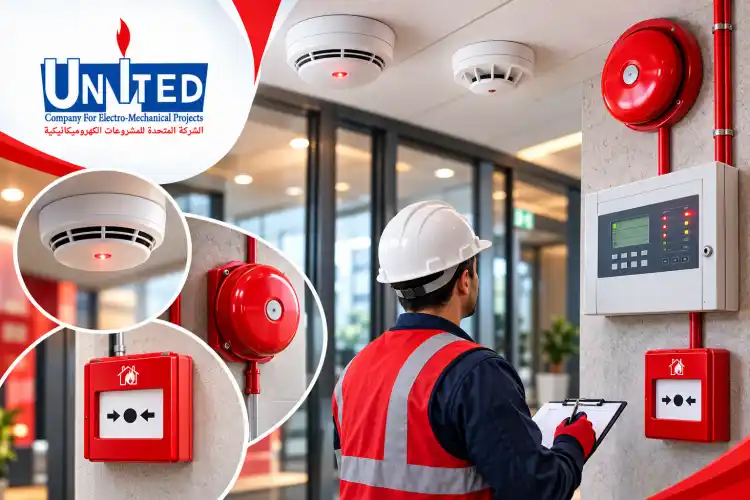
A fire alarm system is an integrated security network that relies on the synchronization of its various components to operate at peak efficiency in the event of an emergency. When Installing fire alarm system for smart protection in your facility, it is essential to ensure the availability and selection of genuine, certified components that guarantee rapid response and accurate alerts. The system primarily consists of:
Main control panel (Fire Alarm Control Panel)
The control panel is the "mastermind" and the most important element in the Installing fire alarm system for smart protection process; it connects and receives all signals issued from sensors and manual breakers, then analyzes them and issues immediate commands to alarm devices (sirens) and fire extinguishing systems.
Its main technical functions:
- Accurately locate the hazard or activated detector (in addressable systems).
- Monitoring the safety of the network and wiring, and providing immediate alerts in case of any malfunction or power outage.
- The provision of backup emergency batteries ensures that the system continues to operate even during power outages.
At United Company, we provide internationally certified control panels approved by civil protection (such as Zeta, Simplex, Hochiki) with programming and development according to your facility plans.
Smoke and heat sensors and detectors.
These detectors represent the "eyes and ears" in fire alarm systems that operate around the clock to detect the first signs of fire before it worsens. The appropriate type of detector is determined based on the nature of the activity and the location:
- Smoke detectors:
- Optical: Ideal for offices, administrative rooms, and corridors, where smoke from slow-burning fires is detected.
- Ionization: Designed for the rapid detection of fine particles and fast-burning fires.
- Heat detectors:
- It is used in places that naturally contain smoke or vapors (such as kitchens, heating and generator rooms, and factories), where it senses sudden or excessive rises in temperature and avoids false alarms.
- Multi-criteria detectors: When Installing fire alarm system for smart protection, they combine smoke and heat detection technology to achieve the highest levels of accuracy and reduce false alarms in critical facilities.
Manual breaker alarms and sirens
It is the direct means of informing and alerting those inside the building of the need for rapid evacuation when danger is perceived:
- Manual Breaker / Manual Call Points:
- They are installed next to entrances, stairwells, and emergency exits to enable anyone to manually trigger the alarm with a single press or by breaking the protective glass as soon as any smoke or fire is noticed.
- Sirens and warning lights (Sounders & Strobes):
- Audio alarm: It emits high-pitched alarm sounds (exceeding a certain decibel level) that are audible throughout the building.
- Visual Strobes: Powerful flashing red lights to alert people in noisy areas or those with disabilities (hearing impairments).
The United Company's engineering team offers a free site visit to determine the ideal placement for fire alarm systems according to Egyptian code and civil defense requirements. Contact us now via WhatsApp or direct call to receive a customized quote.
How to choose the most suitable system? (Comparison between the addressable and traditional systems)
When planning to secure any facility, safety engineers and business owners face a pivotal choice that cannot be divided in two: Do we choose the conventional system or the addressable system?
This decision is not only about the budget, but also about the safety of lives, speed of response, and the ability to easily meet civil protection requirements to obtain a license. Here is a comprehensive comparison table: Which is the most suitable for your facility?
|
Comparison point |
Conventional system |
Addressable system |
|
How to locate a fire |
It defines the area or phase in general (Zone), such as: (The entire first floor). |
The labeled detector accurately identifies the location of the fire, for example: Detector No. 12 – Room 104. |
|
Ideal facility size |
Small and medium spaces (shops, administrative offices, showrooms). |
Large and vital facilities (hospitals, malls, hotels, factories). |
|
Network capacity and expansion |
Limited to a specific number of areas linked to the control panel. |
Flexible and massively expandable to accommodate hundreds of smart detectors on the same loop. |
|
False alarms and maintenance |
The probability of false alarms is relatively high, and it is difficult to accurately identify the detector causing the problem. |
Almost zero, with the ability to calibrate and program the sensitivity of each detector individually remotely. |
|
Connection method and cables |
It requires separate extensions and cables for each area separately. |
It relies on a closed-loop system that saves wires and effort. |
|
Investment cost |
The devices are economical, but the cost of extending them may increase as the space expands. |
Advanced devices, but they cleverly save on cable lengths, effort, and maintenance lifespan. |
Choosing the wrong fire alarm system could lead to wasting your budget, or worse; having your engineering license rejected by the Civil Protection Authority.
Don't worry about the confusion; our expert engineers will visit your site and conduct a completely free engineering feasibility study and inspection, to recommend the system that achieves the highest security equation at the lowest possible cost.
Technical steps for Installing fire alarm system for smart protection according to engineering codes
Installing fire alarm system for smart protection is not limited to wiring and mounting. Fire Smoke Detector Rather, it requires careful engineering planning in accordance with approved codes and standards to ensure rapid fire detection and response, and to reduce false alarms.
The following are the four basic stages that safety engineers rely on to execute Installing fire alarm system for smart protection efficiently and professionally
First: Engineering planning and sensor distribution
- The installation process begins with studying the engineering plans and determining the facility’s needs according to its area and the nature of its activity, while assessing the areas most exposed to fire and distributing smoke and heat detectors, and determining the locations of glass breakers and sound and light sirens to ensure rapid response and ease of evacuation.
Second: Extension of fire-resistant networks and cables
- The efficiency of the system depends on the extension of appropriate and approved cables, protecting them within dedicated routes from damage and moisture, and separating them from the power cables according to technical specifications to reduce interference and ensure signal stability.
Third: Hardware installation, programming, and operational testing
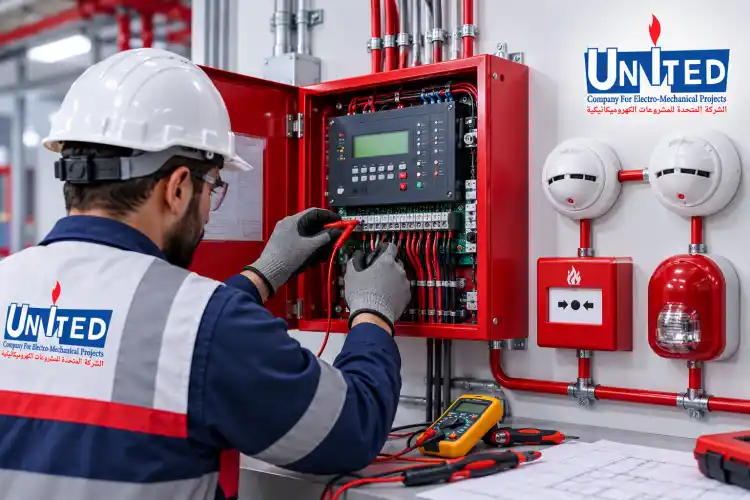
- This phase includes installing the main control panel (FACP), detectors, and alarms in their designated locations, programming the system and assigning detector positions to addressable systems, and connecting it to other systems as needed. Finally, the detectors, panel, and alarms are tested to ensure operational efficiency, with the results documented in a technical report.
United Company provides services Fire Fighting System Installation Starting from engineering planning and equipment supply to testing and delivery, while adhering to safety requirements and the requirements of the competent authorities.
Civil protection requirements when supplying and installing alarm systems
The Civil Protection Authority in Egypt sets technical requirements for Installing fire alarm system for smart protection, considering them a safety requirement that may affect the issuance or renewal of licenses for some establishments. Therefore, adherence to the approved standards is essential to avoid inspection and licensing issues.
Key requirements for Installing fire alarm system for smart protection
- Equipment approval: Selecting control panels, detectors, and sirens that conform to approved specifications and codes.
- Geometric layout: Determining the locations of detectors, glass breakers, and alarm devices according to the area of the facility and the nature of its use.
- Safety of wiring: Use appropriate, fire-resistant cables when Installing fire alarm system for smart protection, and protect them within designated paths.
- Continuity of operation: Providing backup batteries and connecting the system to other fire suppression and control systems when needed, according to the approved design.
United Company helps you design, supply and install fire alarm systems in accordance with approved technical requirements, with support for inspection and delivery procedures to the competent authorities.
Criteria for selecting the best fire alarm installation companies in Egypt
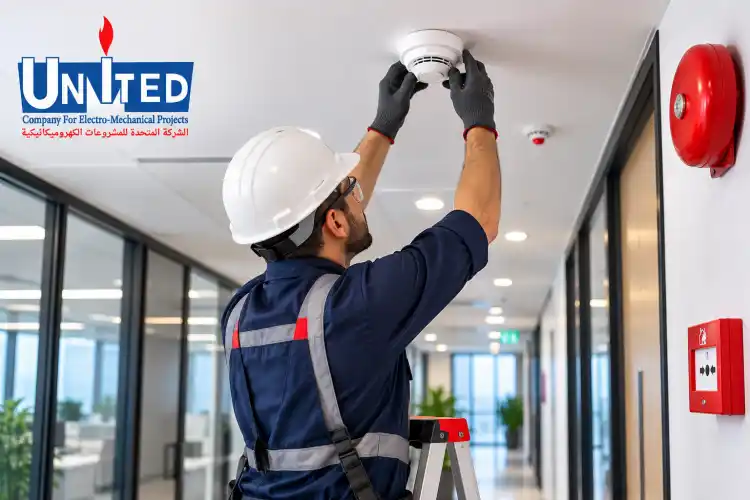
Choosing the right company to handle Installing fire alarm system for smart protection is a crucial step in ensuring the safety of your facility and compliance with civil defense regulations. Therefore, be sure to select the best Fire Alarm Installation Company that possesses technical expertise and specialized staff and adheres to approved specifications.
- Licenses and approvals: Ensure that the company meets the legal requirements before Installing fire alarm system for smart protection devices, and uses devices that conform to approved specifications.
- Experience and track record: Reviewing previous projects in factories, warehouses, commercial and administrative buildings, and requesting an engineering inspection before determining the cost.
- Technical Team: Choosing a company that has engineers and technicians specializing in installing, programming, and testing the efficiency of systems according to applicable codes.
- Warranty and Maintenance: Ensure that a warranty is available on the devices and that periodic maintenance services and technical support are provided to ensure the continued efficiency of the system.
upcoegypt provides integrated fire alarm systems design, supply and installation services, with attention to technical specifications and safety requirements, along with maintenance and technical support services to keep systems ready. Contact United Company now to request an engineering inspection and determine the appropriate system for your facility according to its needs and budget.
Frequently Asked Questions
What is the appropriate height for installing a smoke detector?
Smoke detectors are typically installed in the ceiling, taking into account the spacing requirements for wall mounting, ceiling height, detector type, and manufacturer's instructions.
Is it possible to install an alarm system without breaking into walls?
Yes, by using wireless alarm systems or extending cables inside external (PVC/EMT) conduits systematically mounted on walls and ceilings.
How often should the control panel batteries be tested?
Batteries should be inspected and maintained according to the manufacturer’s recommendations, with thorough periodic system tests carried out by a qualified technician to ensure readiness.